How many books does the average person read in a year? It depends on where you live, how you count, and whether audiobooks make the list. This page collects the most reliable reading data from 2024-2026, organized by country, format, and demographics. Bookmark it - we update it annually.
How much do people read?
The short answer: most adults in developed countries read between 5 and 17 books per year, with large gaps between countries. The US leads in raw book count, while several Asian countries lead in reading participation rate.
According to World Population Review data, global reading rates have held roughly steady over the past decade. What has changed is format - audiobook and ebook consumption is growing faster than print in most markets, though print still accounts for the majority of book sales worldwide.
The reading tracker app market reached $1.42 billion in 2024 and is projected to grow at a 14.6% compound annual growth rate through 2033. That growth reflects a broader trend: readers are paying more attention to their reading habits, not just the books themselves.
Reading by country
Here are the most recent per-capita reading statistics for 11 countries where reading tracker apps are most popular. Books per year reflects all formats (print, ebook, audiobook) where available.
| Country | Books/Year | Hours/Week | Participation |
|---|---|---|---|
| United States | 17.0 | ~7.0 | 75% |
| United Kingdom | 15.0 | ~6.5 | 74-76% |
| France | 14.0 | ~5.8 | 68-72% |
| Italy | 13.0 | ~5.3 | 60% |
| Spain | 9.0 | ~3.6 | 68.5% |
| China | 6.61 | ~3.0 | 76.3% |
| Germany | 6.25 | ~2.7 | 68-70% |
| Japan | 6.20 | ~2.6 | 77-79% |
| Turkey | 6.05 | ~2.5 | - |
| South Korea | 5.69 | ~2.4 | 62-65% |
| Brazil | 5.61 | ~2.4 | 56% |
Sources: World Population Review, Booketic, European Commission statistical reports. Hours/week estimated from annual reading time data.
A few things stand out. The US has the highest book count, but Japan and China have higher adult participation rates. France and Italy read fewer books than the US and UK but spend more time per book on average, likely reflecting a preference for longer literary fiction.
Germany's lower books-per-year number is misleading if taken alone. German readers spend more time reading non-fiction and longer works. The country also has a strong library culture, with over 9,000 public libraries serving a population of 84 million.
Reading formats: print vs ebook vs audiobook
Print still dominates. Physical books account for roughly 75-80% of unit sales in the US and Europe, a share that has held steady for several years despite predictions of a digital takeover.
Ebooks account for about 15-20% of the market in the US and UK, with lower shares in continental Europe and Asia. Growth has plateaued in most markets.
Audiobooks are the growth story. The format has grown at double-digit rates for nearly a decade. In the US, audiobook revenue surpassed $2 billion in 2024. Commuters, gym-goers, and parents with limited reading time are driving the shift. The question "do audiobooks count?" comes up in every reading challenge community. The answer most communities have landed on: yes.
| Format | US Market Share | Growth Trend |
|---|---|---|
| ~75-80% | Stable | |
| Ebook | ~15-20% | Flat |
| Audiobook | ~5-8% | Growing 15-20%/year |
Who reads the most?
Women read more than men in every country where data is available. In the US, women read an average of 19 books per year compared to 15 for men. The gap is similar in Europe. Women are also more likely to use reading trackers, join book clubs, and participate in reading challenges.
Age matters, but not the way you might expect. The 25-44 age group reads the most by book count, partly because they're the most likely to use audiobooks during commutes and exercise. Older adults (55+) read for more hours per week but finish fewer titles, favoring longer books and rereading.
Education is the strongest predictor. Adults with college degrees read roughly three times as many books per year as adults without a high school diploma. Income follows a similar pattern, though the gap narrows when free library access is strong.
How reading habits are changing
BookTok changed discovery. TikTok's book community has turned backlist titles into bestsellers overnight. Colleen Hoover, Sarah J. Maas, and Ali Hazelwood all saw sales spikes driven by BookTok recommendations. The platform has a measurable effect on what gets read, especially among readers under 30.
Subscription fatigue is real. According to C+R Research, 41% of consumers report subscription fatigue, and 89% underestimate how much they spend on recurring charges. In the books and reference category on iOS, 77% of consumer spending goes to one-time purchases, not subscriptions (Sensor Tower). Readers are willing to pay for tools - they just want to pay once.
Tracking is growing. The reading tracker app market was valued at $1.42 billion in 2024, with projections reaching $4.41 billion by 2033 at a 14.6% CAGR. Apps like StoryGraph grew from zero to over 5 million signups in under five years. More readers want to see their own data - books per month, pages per year, genre breakdowns, reading streaks.
Privacy concerns are rising. Readers are leaving platforms owned by large retailers over data practices. German readers in particular have moved away from Amazon-owned reading platforms, citing data privacy as a primary concern. Local privacy-focused alternatives are growing in Germany, France, and Japan.
Track your own reading stats
If these numbers made you curious about your own habits, a reading tracker can show you. Most apps track books per month, pages per year, time spent reading, and genre distribution.
What keeps showing up in reading communities is that readers care about their own patterns more than global averages. The numbers that matter aren't how many books the average American reads. They're things like which months you read the most, whether your taste has shifted, how long you actually spend reading per session, and what your finish rate looks like compared to last year. Statistics become interesting when they tell a personal story. A good tracker should help you see that story without turning it into homework. If your reading goals have started to feel more like pressure than motivation, you're not alone. That tension comes up a lot.
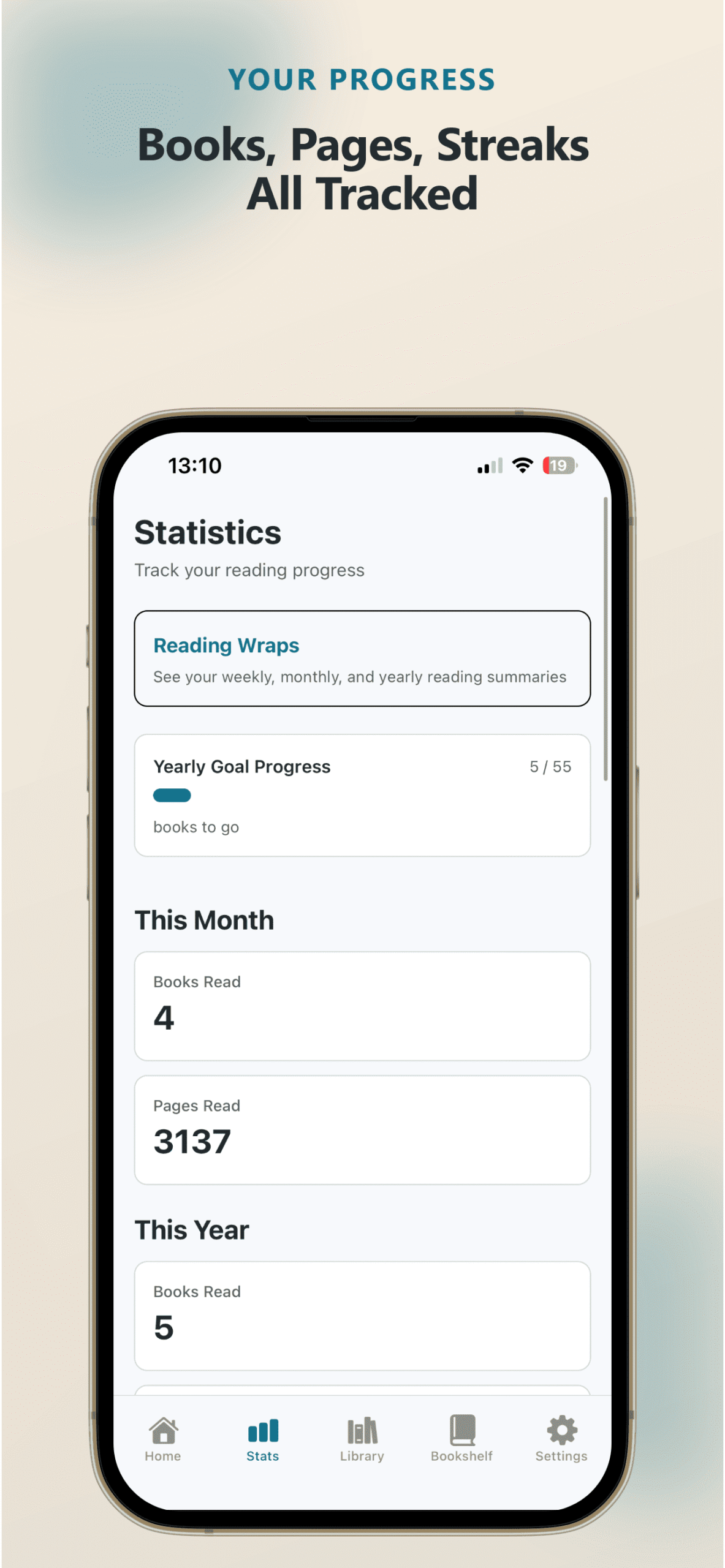
PagePath shows you books finished this month, pages read this year, daily reading streaks, a reading calendar of reading sessions, and weekly/monthly reading wraps. All data stays on your phone. You can also start with a printable reading log if you prefer paper.
For more options, see our complete guide to tracking what you read, our reading challenge guide for 2026, or learn how different book rating systems affect what your stats actually tell you.
Sources
- World Population Review - Books per capita by country
- Booketic - International reading habits survey data
- European Commission (Eurostat) - Cultural statistics: reading participation across EU member states
- C+R Research - Consumer subscription fatigue study (41% figure)
- Sensor Tower - iOS app monetization by category (77% one-time purchases in books/reference)
- Pew Research Center - Demographics of reading in America
- Audio Publishers Association - US audiobook revenue data
Frequently asked questions
See your own reading stats
PagePath tracks books per month, pages per year, reading streaks, and more. All data stays on your phone.