Every January, millions of readers pick a number. 52 books. 100 books. A book a week. By April, most have quietly abandoned it.
The problem is rarely motivation. It's that the goal didn't match their actual life. Here's how to set a reading goal that sticks - and what to do if it doesn't.
What readers say about goal pressure
The most common reading goal complaint across book communities is not "I didn't read enough." It is "the goal changed how I read." Readers describe picking shorter books to inflate their count, avoiding challenging reads because they take too long, and treating reading like a productivity metric instead of something they do because they enjoy it. The readers who stick with their goals tend to track pages or time alongside books, not instead of them, because those metrics reward engagement rather than speed. If your goal has already become a source of guilt, see our piece on reading without the pressure.
Part of our book tracking guide · See also: reading challenges
Why most reading goals fail
Three patterns show up over and over.
No baseline. If you don't know how many books you read last year, picking a number for this year is guessing. Most people overestimate. They remember the good months and forget the dry stretches.
The number is borrowed. "52 books" comes from the 52 Book Club. It's a great challenge for people who already read 40+ books a year. For someone who read 10 last year, it's a recipe for guilt by March.
No check-ins. Setting a goal in January and checking in December means 11 months of no feedback. Monthly check-ins are what keep goals alive.
Find your baseline first
Before you pick a number, figure out where you actually are. Look back at the past 12 months. Count finished books only - not the ones you started and abandoned, not the ones sitting on your nightstand.
If you can't remember, you're not alone. That's the whole reason people start tracking. Spend one month logging what you read, then extrapolate.
How many books do people actually read?
| United States | 17 books/year |
| United Kingdom | 15 books/year |
| France | 14 books/year |
| Germany | 6.25 books/year |
| Japan | 6.2 books/year |
| Brazil | 5.6 books/year |
Sources: World Population Review, Booketic, European Commission
If you're reading 12 books a year, you're already above the global average. That matters when you're deciding what to aim for.
Set the right number
Take your baseline and add about 20%. That's your stretch goal. If you read 12 books last year, aim for 15. If you read 30, try 36. The goal should feel reachable with a bit of effort - not require a lifestyle overhaul.
Book count isn't the only way to measure. Depending on what you want to get out of reading, consider these alternatives:
| Book count | The classic. Simple, easy to measure. Favors shorter books. |
| Page count | Fairer if you read long novels. 5,000 pages/year = roughly 15 average-length books. |
| Time-based | 20-30 minutes a day. Doesn't penalize slow readers or complex books. |
| Genre diversity | Read from 8 different genres this year. Good if you're stuck in a rut. |
You can combine them. "Read 20 books from at least 5 genres" is a better goal than "read 52 books" for most people.
Track progress, not just the finish line
A year-end number tells you whether you hit the goal. Monthly check-ins tell you whether you're on track to hit it - early enough to adjust.
At the end of each month, look at three things:
- Books finished this month vs. your monthly target
- Pages read this month vs. last month (are you speeding up or slowing down?)
- How your reading time is distributed (weekdays vs. weekends, morning vs. evening)
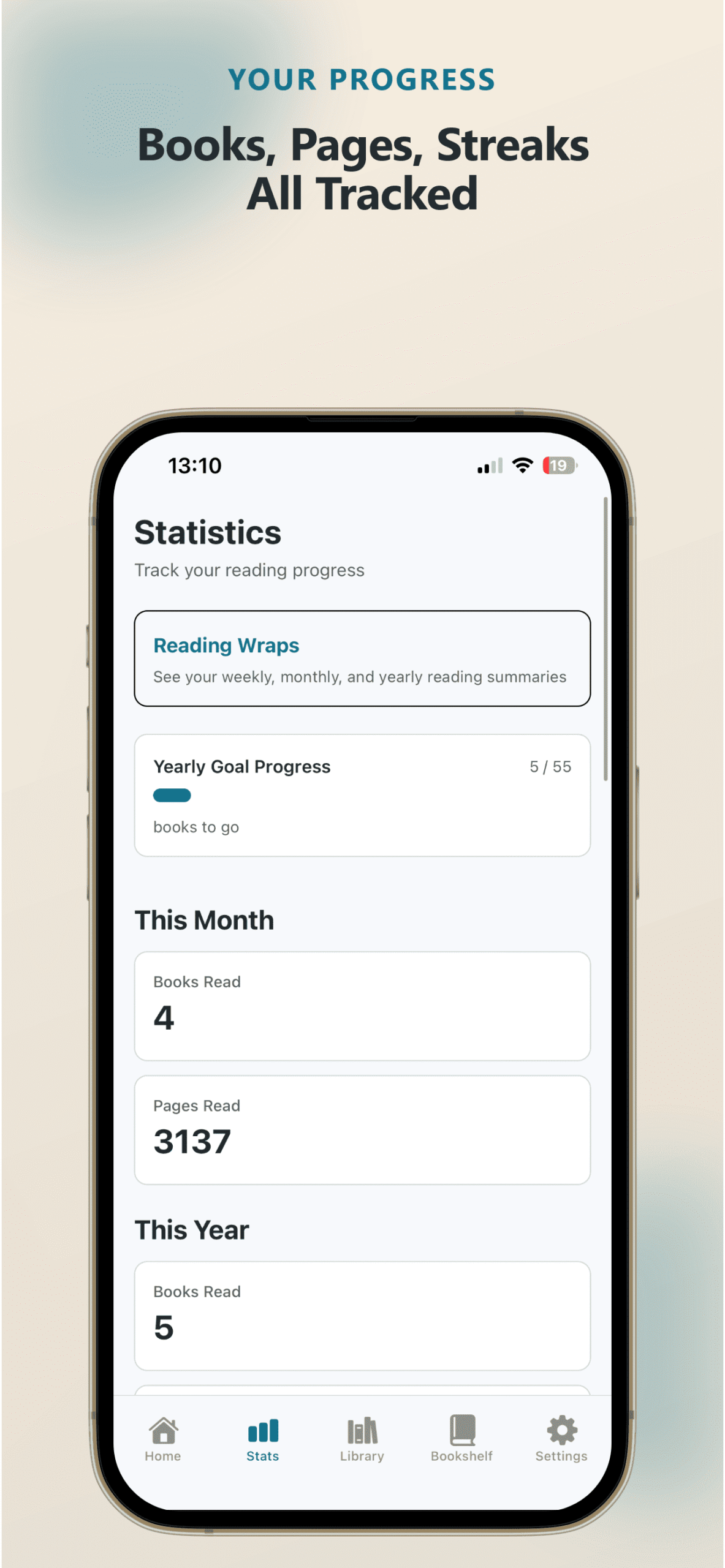
These patterns are hard to see without a tracker. A notebook works if you're disciplined. A spreadsheet works if you like spreadsheets. An app like PagePath calculates this for you - it shows books and pages per month, a reading streak calendar, and monthly wraps that compare your current month to the last one.
What to do when you fall behind
You will fall behind at some point. Work gets busy. A book takes longer than expected. You hit a reading slump. This is normal.
Here's what helps:
- Lower the number. Changing from 24 to 18 mid-year is not quitting. It's adjusting to reality.
- Switch formats. Audiobooks during commutes. Short story collections. Graphic novels. They all count.
- Stop forcing books you don't enjoy. DNF (did not finish) is a valid status. Forcing yourself through a bad book wastes the time you could spend on one you'd actually like.
- Read shorter books to rebuild momentum. Finishing three 200-page books feels better than being stuck on page 300 of a 700-page novel for six weeks.
Reading 15 books in a year puts you ahead of most people in most countries. If your goal was 24 and you finished 15, that's a good year - not a failure. For more on this: Behind on your reading challenge? Here's why that's fine.
Tools that help
You don't need a special tool to track a reading goal. But the right one makes monthly check-ins easier.
| Notebook | Simple, no tech needed. Hard to see trends unless you do the math yourself. Best for people who enjoy the ritual of writing by hand. |
| Spreadsheet | Flexible. You can build charts and formulas. Requires setup and discipline to update. Google Sheets works on your phone if you need mobile access. |
| Goodreads | Has a yearly reading goal counter built in. Shows a progress bar. Limited stats beyond the number. Requires an account and stores your data online. |
| PagePath | Sets a yearly goal with a progress ring on your home screen widget. Monthly reading wraps show books, pages, genres, and time spent. All data stays on your phone. Free for 25 books, $9.99 one-time for unlimited. |
If you're coming from Goodreads and want to keep your history, most apps accept a Goodreads CSV export.
If you prefer paper, we have a free printable reading log you can download and print.
Looking for a specific reading challenge to follow? Our 2026 reading challenge guide covers the most popular ones.
Frequently asked questions
Set your reading goal and see it on your home screen
PagePath shows your goal progress in a widget, tracks pages and books per month, and celebrates milestones without guilt. Free for your first 25 books.