A reading challenge gives your reading year a shape. Instead of vaguely planning to "read more," you pick a number, a theme, or a set of prompts - and then you work through them at your own pace.
This guide covers the most popular reading challenges running in 2026, how to build your own if none of them fit, and practical ways to track your progress without turning reading into a chore. If you're looking for a broader overview of challenges across years, see our complete reading challenges guide.
Patterns from reading discussions
Reading challenges get the most enthusiastic posts in January and the most frustrated ones by mid-year. The readers who stay engaged tend to treat the challenge as a direction, not a deadline. They swap out prompts that do not fit, count audiobooks and graphic novels without hesitation, and adjust the number when life changes. The ones who abandon the challenge usually say the same thing: the number took over, and reading stopped being fun. If that sounds familiar, we have a separate piece on handling reading challenge guilt, and another on setting goals that actually stick.
What is a reading challenge?
A reading challenge is a structured goal for how many books you'll read, what kinds of books you'll pick, or both. Some challenges give you a flat number (read 52 books in a year). Others hand you a list of prompts ("a book with a one-word title," "a book set in a country you've never visited") and you match one book to each prompt.
The point isn't pressure. A good challenge pushes you to try books you wouldn't normally pick up - a genre you've avoided, an author from a different country, a classic you keep meaning to read. The number is a guideline, not a contract.
The average American reads about 17 books per year. If you read 20, you're ahead of most people. If you read 10 and enjoyed every single one, that's a better year than someone who rushed through 50 and can't remember half of them.
Popular reading challenges for 2026
These are the challenges with the biggest communities and the most momentum heading into 2026. All of them are free to join.
The 52 Book Club
52 prompts · 27,000+ members on Goodreads · All genres welcome
One book per week, each matched to a creative prompt. The prompts cover everything from cover design to character types to settings. You can read in any language and any genre. Think of it as a bookish scavenger hunt - the prompts are designed to pull you out of your comfort zone without being rigid about it. The community is active on Goodreads, StoryGraph, Instagram, and Facebook.
PopSugar Reading Challenge
50 prompts (40 regular + 10 advanced) · Running since 2015
Now in its 11th year. The prompts are specific but flexible - things like "a book with a trans or nonbinary protagonist," "a book under 260 pages," or "a book you meant to read in 2025." The advanced prompts are harder to match, which is the fun of it. You don't have to finish all 50. Many people aim for 20-30 and treat the rest as stretch goals.
Book Riot's Read Harder Challenge
26 prompts · Diversity-focused · 2 per month
Two prompts per month, focused on expanding what you read. The prompts specifically ask for work by intersex, deaf, African, and other underrepresented authors. If you want to diversify your reading without doing the research yourself, this challenge does the work of pointing you in the right direction. 26 books is also a more manageable pace than 52 - one every two weeks.
Around the World
Read one book set in or written by an author from every continent, region, or country. Scale it to your ambition - 7 continents is doable, 50 countries is a multi-year project.
A to Z Challenge
Read 26 books, one for each letter of the alphabet (by title or author last name). Simple, no prompts to interpret. Letters like Q, X, and Z make it interesting.
Rory Gilmore Challenge
339 books mentioned or read in Gilmore Girls. Not a one-year challenge - most people work through it over several years. Heavy on classics and literary fiction.
The 52 book challenge: is it realistic?
The 52 Book Club is the most popular challenge on this list, but one book per week is a serious commitment. Here's the honest math.
The average book is about 300 pages. At 52 books, that's 15,600 pages per year.
That breaks down to 42 pages per day, every day, with no days off.
At an average reading speed, that's about 45 to 60 minutes of daily reading.
The average American reads 17 books per year. So 52 is roughly three times that. If 52 feels too aggressive:
| Goal | Pace | Daily pages | Daily time |
|---|---|---|---|
| 12 books | 1 per month | 10 | ~12 min |
| 26 books | 1 every 2 weeks | 21 | ~25 min |
| 52 books | 1 per week | 42 | ~50 min |
| 100 books | ~2 per week | 82 | ~1.5 hrs |
Tips from people who actually finish 52:
- Mix short and long. Alternate a 600-page novel with a 200-page memoir. Keeps your average pace near one per week.
- Count audiobooks. A 30-minute commute is 5 hours of listening per week. That's a full audiobook every two weeks without extra time.
- Read two books at once. Keep a lighter book alongside your main read for low-energy days.
- Set a daily page minimum. 42 pages a day adds up to 52 books without weekly deadlines.
- Drop books you don't enjoy. Spending three weeks on a book you hate is the fastest way to fall behind.
For the full 2026 prompt list, visit the52book.club.
Create your own reading challenge
None of the big challenges have to be your challenge. You can build one that fits how you actually read.
Pick a number. Be honest about your pace. If you read 12 books last year, setting a goal of 52 is setting yourself up to quit in March. Try 15 or 18 instead. You can always raise it mid-year if you're ahead.
Pick a theme (or don't). A flat number works fine. But if you want structure, choose one constraint: only debut novels, only books under 300 pages, only authors from your country, only books published before you were born. One rule is enough to change what you reach for.
Set monthly checkpoints. Divide your yearly goal by 12 and check in at the end of each month. If your goal is 24 books, that's 2 per month. If you're at 1 in January, you know early. If you're at 3, you're ahead and can relax.
Here are some custom challenge ideas to get started:
- Genre explorer: Read one book from 10 genres you've never tried
- Local authors: Read 12 books by authors from your country or region
- Decade walk: One book from each decade, 1920s through 2020s
- Reread challenge: Revisit 6 books that shaped how you think
- Short stack: Read 20 books under 200 pages - clear the novellas and short story collections on your shelf
- Translation challenge: Read 12 books originally written in a language other than English
How to track your reading challenge
The tracking method matters more than people think. If checking your progress is annoying, you stop checking. If you stop checking, you lose momentum.
| Method | Best for | Trade-off |
|---|---|---|
| Paper log | People who like writing by hand and don't need stats | No automatic totals, easy to lose |
| Spreadsheet | People who want custom columns and formulas | Setup time, not great on mobile |
| Reading tracker app | People who want automatic stats, streaks, and visual progress | Another app on your phone |
If you go with a paper log, we have a free printable reading log (PDF) you can download and print.
If you prefer an app, PagePath has a reading goal feature where you set a yearly target and see your progress as a ring that fills up over the year. Monthly and yearly reading wraps show you books finished, pages read, genres, and time spent - useful for checking in on your challenge without doing the math yourself. You can also tag books by challenge prompt if you're following a specific list.
Whatever you pick, the key is checking in regularly. A tracker you update once a month is more useful than one you fill in perfectly for two weeks and then abandon.
Staying motivated without the guilt
Most reading challenges die in April. You start strong in January, fall behind in February, and by spring the gap between where you are and where you "should" be feels too wide to close. So you stop tracking, and eventually you stop thinking about the challenge altogether.
This is a design problem, not a willpower problem. Here's how to fix it:
Lower the number instead of quitting. If you set 52 and you're at 6 in April, change the goal to 24. You're not failing - you're adjusting based on real data. A finished challenge of 24 books beats an abandoned challenge of 52.
Count DNFs. If you read 100 pages of a book and decided it wasn't for you, that's reading. Some challenges don't count "did not finish" books. Yours can. You tried it, you made a decision, you moved on. That counts.
Stop comparing pace. BookTok and Bookstagram are full of people who read 150 books a year. Most of them read romance novellas, which average 200-250 pages. Someone reading 800-page literary fiction at the same pace would finish 40 books. The number alone doesn't tell you much.
Focus on the streak, not the total. Reading 15 minutes every day for a month is a bigger shift than binge-reading 3 books in a weekend and then not touching a book for three weeks. Consistency beats volume.
Reading challenges are supposed to make reading more fun. The moment a challenge makes reading feel like homework, the challenge needs to change - not you.
If you're feeling behind on your challenge, we wrote a separate piece on that: Behind on Your Reading Challenge? Here's Why That's Fine.
Want to track your reading challenge on your phone? PagePath is free for your first 25 books - set a yearly goal, track your time, and see your progress without creating an account.
Frequently asked questions
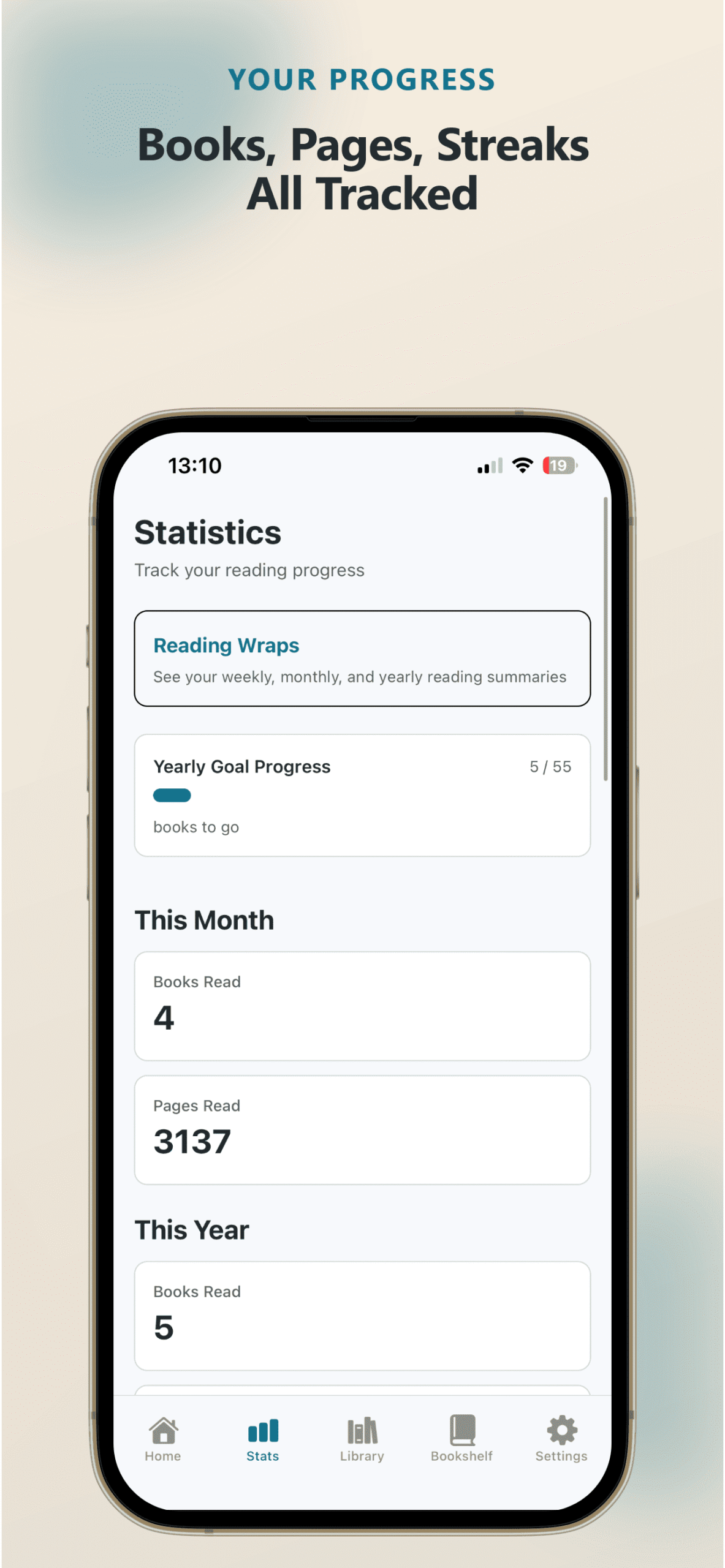
Track your challenge on your phone
PagePath tracks your books, reading time, and yearly goal - all on your device. No account, no subscription. Free for your first 25 books.
Part of our Reading Challenges Guide · See also: Book Tracking Guide